
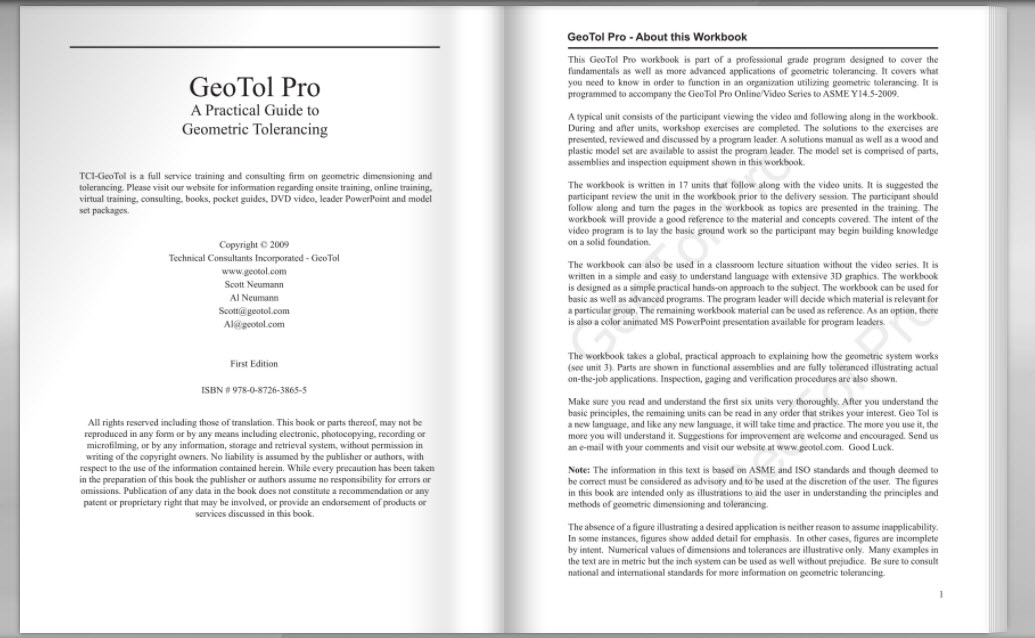
eBook GeoTol Pro 2009 Workbook

$60.00

The GeoTol Pro 2009 in Ebook format. Based on the ASME Y14.5-2009 Standards. Access is through our GeoTol U portal and is not available for download.

Get $10 off a workbook (ebook or printed version) with the purchase of any of the GeoTol Pro Online courses. No code needed.

    Description

    The GeoTol Pro 2009 Fundamentals Workbook (eBook) is a streamlined, full-color learning resource designed to help users confidently understand and apply geometric dimensioning and tolerancing (GD&T). Aligned with the ASME Y14.5-2009 standard, this workbook supports the GeoTol Pro 2009 Online Program, DVD series, and PowerPoint course—but is also effective as a stand-alone reference.

    With 380 pages of illustrations, examples, and guided exercises, it walks learners from basic GD&T concepts to more advanced topics like tolerance boundaries and simple stack-ups. Clear visuals, practical explanations, and chapter-end review questions make it an ideal tool for both individual study and team-based training.

    Features

    • 380 pages of full-color graphics to clarify datums, tolerance zones, and application examples
    • Aligned with ASME Y14.5-2009, with notes comparing earlier ASME and relevant ISO standards
    • 17 structured units that progress from fundamentals to intermediate GD&T concepts
    • Hands-on exercises throughout each chapter for immediate skill reinforcement
    • Easy-to-navigate layout with symbol tables, summaries, and a comprehensive index
    • Compatible with GeoTol training materials, including the online course, PowerPoint, DVD series, and model sets

    Who It’s For

    This workbook is designed for:

    • Engineers & Designers developing or reviewing technical drawings
    • Manufacturing & Production Personnel applying tolerances on the shop floor
    • Quality & Inspection Teams interpreting GD&T for measurement and verification
    • Students & Trainees learning GD&T for the first time
    • Instructors looking for structured, ready-to-teach course material

    View Outline

    GeoTol Pro 2009 Workbook
    Unit 1 Introduction – Symbols and Terms
    Unit 2 Limits of Size
    Unit 3 How the Geometric System Works Part 1&2
    Unit 4 Position Verification
    Unit 5 Product Plans and Virtual Condition
    Unit 6 The Datum Reference Frame I
    Unit 7 Datum Feature Modifiers
    Unit 8 The Datum Reference Frame II – Targets and Irregular Surfaces
    Unit 9 The Datum Reference Frame III – Advanced Concepts
    Unit 10 Form Tolerances
    Unit 11 Orientation Tolerances
    Unit 12 Profile Tolerances Part1&2
    Unit 13 Position Tolerances
    Unit 14 Coaxial Tolerances
    Unit 15 Fastener Formulas and Screw Threads
    Unit 16 Boundaries
    Unit 17 Application Exercises

    Detailed Outline

    • Unit 1: Introduction to Geometric Dimensioning and Tolerancing
      • General overview, geometric characteristic symbols, rules, terms and definitions
      • Introduction to measurement principles, open set-up and CMM
    • Unit 2: Limits of Size
      • Rule #1
      • Features with & without size
      • Regular & irregular features of size
      • Independency principle
      • Limits & fits
    • Unit 3: How the Geometric System Works
      • Problems with plus/minus tolerancing
      • Introduction to the datum reference frame
      • Datum precedence
      • Basic dimensions
      • Introduction to Position Tolerancing
      • MMC, LMC, RFS feature modifiers
      • Introduction to Profile Tolerancing
    • Unit 4: Position Tolerancing and Verification
      • Verifying position
      • More on MMC, LMC, RFS feature modifiers
      • Paper gage
    • Unit 5: Product Plans and Virtual Condition
      • Product definition drawing, manufacturing process plan, dimensional measurement plan
      • Introduction to boundaries
      • Calculating virtual size
      • Perpendicularity as a refinement of position
    • Unit 6: The Datum Reference Frame
      • Datums, datum features, datum feature simulators
      • Holes, slots, shafts, tabs, widths as datum features
      • Connection between the theory and physical
      • Datum feature precedence
      • Constraining the degrees of freedom
      • Datum feature simulator requirements
      • Partial datum features
    • Unit 7: Datum Feature Modifiers
      • MMB, LMB, RMB
      • Calculating boundaries for datum features at MMB
      • Comparison between datum feature modifiers RMB and MMB
      • Simultaneous requirement implied as default
      • Calculating allowable datum feature shift
      • Paper gage calculations
    • Unit 8: Datum Targets and Irregular Surfaces
      • Contoured datum features
      • Datum targets used on sheet metal
      • Datum targets used on castings
      • Calculations from casting to machining
    • Unit 9: Datum Reference Frames, Advanced Topics
      • Hole patterns as datum features
      • Hole and Slot design
      • Translation modifier
      • Multiple DRF
      • Customized DRF
    • Unit 10: Form Tolerances
      • Flatness, Straightness, Circularity, Cylindricity
      • Flatness per unit area
    • Unit 11: Orientation Tolerances
      • Perpendicularity, Parallelism, Angularity
      • Orientation as a refinement of Location
      • Perpendicularity of Zero at MMC
    • Unit 12: More Advanced Profile Tolerances
      • Profile of a surface and line
      • Using profile to control size, form, orientation and location
      • Bilateral and unilateral tolerances
      • Application and verification princip
      • Free state and restrained condition
      • Composite profile
    • Unit 13: More Advanced Position Tolerances
      • Position rectangular, conical, spherical tolerance zones
      • Position boundary
      • Continuous feature
      • Composite position tolerancing
      • Comparison of two single segments vs. composite tolerancing
      • Paper gage calculations
    • Unit 14: Coaxial and Runout Tolerances
      • Two datum features creating a single datum axis (A-B)
      • Position to control coaxiality
      • Circular runout and total runout
      • Concentricity and Symmetry
      • Profile to control coaxiality
      • Comparison of position, concentricity, runout, profile
    • Unit 15: Fixed and Floating Fastener Formulas
      • Calculating position tolerances for clearance holes and tapped holes
      • Screw threads with projected tolerance zones
    • Unit 16: Boundaries
      • Maximum material boundary, least material boundary, inner boundary, outer boundary
      • Introduction to stack ups
      • Calculations for wall thickness
    • Unit 17: Applications
      • Corner Bracket
      • Flange Bearing
      • Powder Case
      • Link